How much protein per day to build muscle?
It's the most repeated question in any gym, and one of the most myth-ridden. Let's answer it with what the evidence actually says — no supplement-brand exaggerations or inflated numbers.
By The DietPlanner Pro Team · Content based on peer-reviewed studies. See methodology
The number the science backs: 1.6–2.2 g/kg
The reference meta-analysis is Morton et al. (2018), which pooled 49 studies and over 1,800 participants. Its conclusion: muscle gain stops increasing beyond roughly 1.6 g of protein per kilogram of body weight per day.
Above that figure the benefits are minimal, but going up to 2.2 g/kg acts as a useful safety margin, especially if you're in a calorie deficit or are an experienced lifter. In practice, the 1.6–2.2 g/kg range covers almost everyone.
Which body weight to base it on
Most people use total body weight. But if you carry a high body-fat percentage, calculating protein on your lean mass (fat-free weight) avoids overestimating. That's why DietPlanner Pro adjusts protein by your body-fat %: someone at 30% fat doesn't need the same absolute protein as someone at 12%.
Practical examples
- •70 kg person, bulking: 112–154 g of protein per day.
- •80 kg person, cutting (deficit): aim for the high end, ~176 g.
- •60 kg person, maintenance: 96–132 g per day.
Does it matter to split it across meals?
It matters, but less than people think. The most decisive factor is hitting the daily total. That said, splitting protein into 3–5 servings of 0.4 g/kg each (Schoenfeld & Aragon, 2018) optimizes synthesis across the day.
The famous fear of "missing the anabolic window" right after training is greatly overrated: what matters is the total intake over 24 hours, not the 30 minutes after your workout.
Is it dangerous to eat that much protein?
In healthy people, no. Antonio et al. (2016) had trained subjects eat over 3 g/kg for months with no adverse effects on kidneys or liver. The classic warning about protein and kidneys applies to people with pre-existing kidney disease, not the general population.
Best protein sources
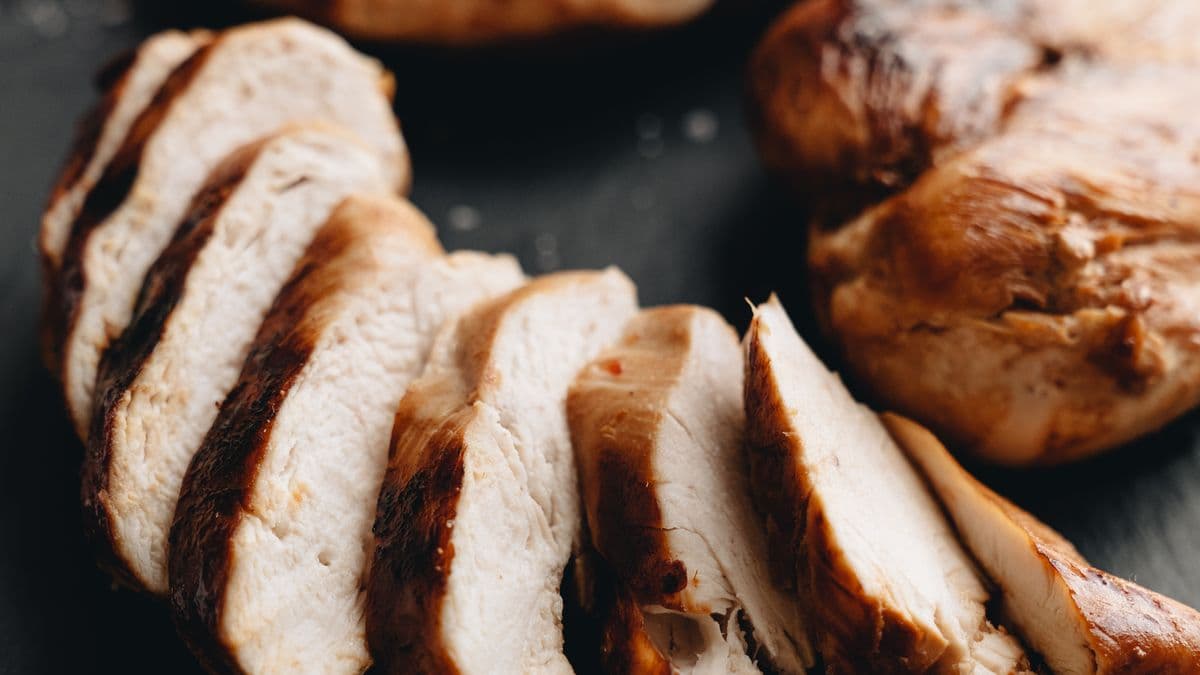
- •Animal: chicken and turkey breast, egg whites and whole eggs, tuna and white fish, lean beef, dairy (Greek yogurt, cottage cheese, milk).
- •Plant: tofu and tempeh, textured soy, seitan, legumes, edamame.
- •Supplements (optional): whey protein or a plant protein isolate if you struggle to hit the total with food alone.
Calculate exactly how much protein and how many calories you need, with a full weekly menu, in under 3 minutes — free.
Calculate my protein and diet freeFrequently asked questions
How much protein per day to build muscle?
Between 1.6 and 2.2 g per kilo of body weight per day. Beyond 1.6 g/kg, muscle gain no longer improves significantly, per the Morton et al. (2018) meta-analysis.
Do I need protein shakes?
They're not mandatory. They're a convenient tool to hit your daily total, but you can cover all your protein with real food if you prefer.
Can I get all my protein in one meal?
You can, but it's not optimal. Splitting it into 3–5 servings across the day makes better use of muscle protein synthesis.